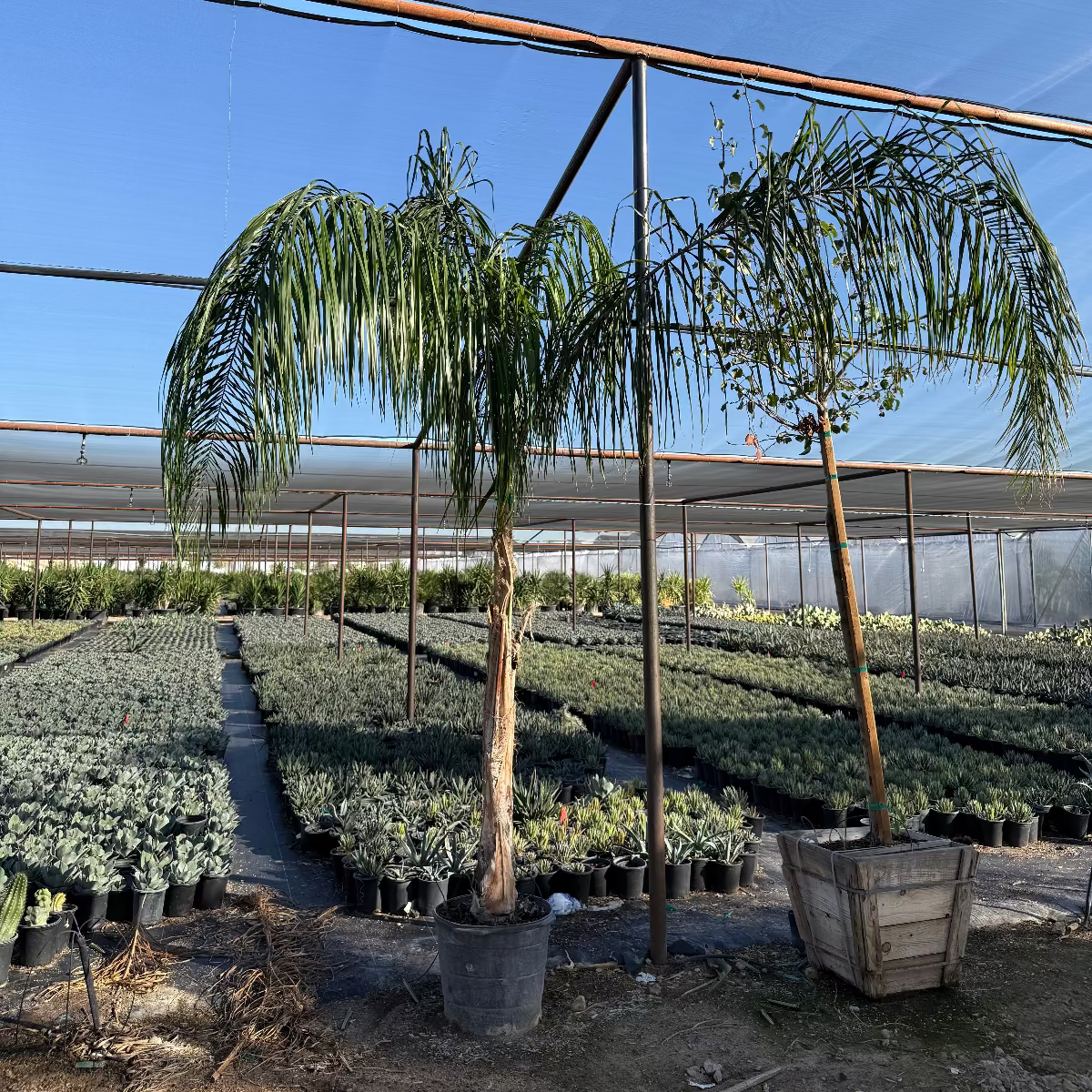
SKU: 12152347865
discount palms and plants

discount palms and plants Buy Queen Palm Phoenix, AZ | Syagrus romanzoffiana

Sale price$20.39 Regular price$22.66
Save 10%

Pay in installments of $5.67 with ShopPay, AfterPay and Klarna

Shipping Estimate
USA
  • USA
  • CAN

Ships within 48 hours · Estimated delivery Sep 16 - Sep 21

Promo Codes Available:

For Your Every Summer RSVP, with Code: SUMMER15

Description

discount palms and plants Buy Queen Palm Phoenix, AZ | Syagrus romanzoffianaElegant Tropical Shade for Phoenix Yards Queen Palm The Queen Palm (Syagrus romanzoffiana) is one of the most graceful and fast growing palms available for Phoenix area landscapes. With long, feathery fronds that arch elegantly from a smooth gray trunk, Queen Palms deliver instant tropical curb appeal to any property. They grow quickly to 3040 feet tall, creating welcome filtered shade in the hottest months. Whether you're framing a Scottsdale

Elegant Tropical Shade for Phoenix Yards — Queen Palm

The Queen Palm (Syagrus romanzoffiana) is one of the most graceful and fast-growing palms available for Phoenix-area landscapes. With long, feathery fronds that arch elegantly from a smooth gray trunk, Queen Palms deliver instant tropical curb appeal to any property. They grow quickly to 30–40 feet tall, creating welcome filtered shade in the hottest months. Whether you're framing a Scottsdale driveway, lining a Chandler pool deck, or adding vertical drama to a Gilbert backyard — the Queen Palm is one of the most popular choices for Valley homeowners and landscape designers alike.

Queen Palm Plant Details

Attribute Detail
Scientific Name Syagrus romanzoffiana
Common Names Queen Palm, Cocos Palm
Mature Height 30–40 feet
Mature Width 15–20 feet (canopy spread)
Growth Rate Fast — 3–6 feet per year in Phoenix
Sun Full sun (6+ hrs). Handles reflected heat from walls and pavement.
Water Moderate. More water than most desert palms, but manageable on drip.
USDA Zones 9b–11 (Phoenix is Zone 9b–10a)
Soil Well-draining preferred. Adapts to Arizona caliche soils with proper planting.
Foliage Evergreen — lush feathery fronds year-round
Fruit Produces small orange date-like clusters in summer

Queen Palm Uses in Phoenix Landscapes

Driveway & Entry Framing

Queen Palms are a top pick for framing driveways and front entries across Scottsdale, Mesa, and Tempe. Their tall, slender trunks and arching canopies create a stately, resort-style welcome. Plant a pair flanking the driveway entrance or line both sides at 12–15 foot intervals for a dramatic allée effect.

Pool & Patio Shade

The Queen Palm's high canopy provides dappled shade without blocking airflow — ideal for poolside comfort in Chandler and Gilbert yards. Fronds are large but don't create excessive litter compared to many broadleaf trees. Pair with low-growing Desert Spoon or Yellow Bells at the base for a layered tropical look.

Streetscape & HOA-Friendly Plantings

Many Phoenix-area HOAs approve Queen Palms for front yards because of their clean, upright form and tropical aesthetic. They work beautifully in median strips, along property lines, and in shared community spaces throughout Peoria, Glendale, and Surprise.

Best Time to Plant Queen Palm in Phoenix

Fall (October–November) is the ideal planting window for Queen Palms in Phoenix. Warm soil promotes fast root establishment while cooler air temperatures reduce transplant stress. The palm gets 6–8 months of root growth before its first full Phoenix summer. Spring (February–April) is the second-best window. Avoid planting in June–August if possible — extreme heat puts extra stress on newly transplanted palms.

How to Plant Queen Palm

  1. Dig wide, not deep — excavate a hole 2–3x the width of the root ball, same depth. Queen Palms don't like being planted too deep.
  2. Check for caliche — break through any hardpan layer to ensure good drainage. Standing water around the root ball will cause root rot.
  3. Backfill with native soil — a light 20% organic amendment is fine, but avoid heavy compost mixes.
  4. Spacing — plant 12–15 feet apart for a grouped planting; 20+ feet for individual specimens.
  5. Water basin — build a 3–4 inch soil ring around the root zone to direct water where it's needed.
  6. Mulch — apply 2–3 inches of bark or gravel mulch to retain moisture and regulate soil temperature.

Watering Queen Palm in Phoenix

First Year Watering Schedule

Queen Palms need consistent moisture during their first year. Water deeply:

  • Weeks 1–2: Every 1–2 days, deep and slow (30–45 min drip cycle)
  • Months 1–2: Every 3–4 days
  • Months 3–6: Every 5–7 days (every 3–4 days during peak summer heat)
  • After Year 1: Every 7–10 days in summer; every 2–3 weeks in winter

Drip Irrigation

Place 2–3 emitters (2 GPH each) in a ring 18–24 inches from the trunk. As the palm matures, move emitters outward to the drip line. Established Queen Palms are moderate water users — not as drought-tolerant as Mexican Fan Palms, but very manageable on a standard drip system.

How fast does Queen Palm grow in Phoenix?
Queen Palms are one of the fastest-growing palms for the Phoenix Valley, adding 3–6 feet of height per year with regular watering. Most homeowners see their palm reach 20+ feet within 4–5 years of planting a 15-gallon size.

Is Queen Palm drought tolerant?
Queen Palms are moderately drought tolerant once established — more water-dependent than Mexican Fan Palms or Mediterranean Fan Palms, but far less thirsty than most tropical trees. On a well-designed drip system, they perform beautifully in the Phoenix climate.

What's the difference between Queen Palm and Pygmy Date Palm?
Queen Palms grow to 30–40 feet and serve as full-size landscape trees, while Pygmy Date Palms max out at 8–10 feet and work best as patio or accent plants. Both are feather palms with an elegant look, but Queen Palms provide much more shade and vertical impact.

Do Queen Palms survive Phoenix summers?
Yes. Queen Palms handle Phoenix summers well as long as they receive regular deep watering. They tolerate reflected heat from walls and pavement and rarely show heat stress when properly irrigated.

Do Queen Palms drop fruit?
Yes — Queen Palms produce small orange fruit clusters in summer. The fruit is not harmful but can create litter on patios and pool decks. Regular cleanup or planting away from high-traffic hardscapes keeps this manageable.

You May Also Like

  • Pygmy Date Palm — a compact feather palm for patios and small spaces, growing just 8–10 feet tall.
  • Mexican Fan Palm — a towering, drought-tough fan palm that reaches 50–70 feet with minimal water.
  • Mediterranean Fan Palm — a slow-growing multi-trunk palm with distinctive fan-shaped fronds, perfect for desert modern landscapes.
  • Pineapple Palm — a showstopper with a unique crown shaft that resembles a pineapple, excellent for entryways.

How Many Queen Palms Do I Need?

Queen Palm is a tall feather palm with a 15 to 20 foot canopy, so it is placed as a specimen, grove, or allee rather than a hedge. Use these layouts:

  • Single specimen: one palm as vertical drama in a lawn or bed, set 20 feet or more from the house and other big trees so the crown spreads freely.
  • Symmetrical pair: flank a driveway or entry with two palms roughly 12 to 15 feet apart.
  • Allee or grove: line a drive or property edge 12 to 15 feet on center for a resort colonnade, staggering heights in informal groves of 3 to 5.

Keep the trunk 8 to 10 feet off pool decks and patios so the summer fruit clusters and frond drop land on planting beds, not paving.

Queen Palm Season-by-Season in Phoenix

  • Spring (Feb–Apr): a strong flush of new fronds and rapid height gain begin as soil warms; a good second planting window.
  • Summer (May–Sep): the fastest growth of the year, with good heat and reflected-heat tolerance as long as deep water is steady. Orange fruit clusters ripen, and monsoon rain is a bonus. This palm wants more water than desert natives through the heat.
  • Fall (Oct–Nov): the prime low-desert planting season; maximizes root growth before summer while the lush crown holds.
  • Winter (Dec–Jan): evergreen but frost-tender, with frond burn possible below about 25 to 28°F. Most Valley winters are fine, but cover young palms on hard-freeze nights and expect established palms to push out fresh fronds in spring after a cold snap.

At a Glance

✔ Heat-Loving (Reflected-Heat Tolerant)   ✔ Evergreen   ✔ Shade-Providing   ✔ Low-Maintenance

Plant It With

  • Mexican Fan Palm: a taller, more drought-tough palm for a layered skyline behind the Queen.
  • Pygmy Date Palm: a compact feather palm that echoes the form at ground level.
  • Mediterranean Fan Palm: a low multi-trunk fan palm that contrasts the single smooth trunk.
  • Desert Spoon: a silver, low-water understory accent for the base of the palm.

Is Queen Palm Right for Your Yard?

Queen Palm thrives in full Phoenix sun and reflected heat, grows fast for quick tropical height, and stays manageable on a standard drip system. It is not a fit if you want a low-water, plant-and-forget palm or a hard-freeze-proof one: it wants more water than desert-native palms, drops fruit that litters poolside paving, and can show frond burn in a hard Valley freeze.

Shipping Notes
  • Free Standard Shipping on $100+ Orders to the USA.
  • Except Preorder products are shipped in 48 hours.
  • Delivery to the USA:
  1. Standard Shipping : 3-10 business days
  • If time is of the essence, please consider selecting expedited delivery for faster service.
Exchange/Return Notes
  • We offer a 30-day return/exchange service after receiving.
  • Final sale items are not eligible for returns or exchanges.
  • To process your return/exchange, please contact us at [email protected]
  • Please click here for more details>>> Return & Exchange Policy
SKU: 12152347865

Discover Niche Categories That Outsell discount palms and plants

Top-Converting Item to Boost Your Average Order

4.4 ★★★★★
Based on 20 reviews
Sort
Highest Rating
Newest First
Oldest First
Product Reviews
M
Matthew Bennett
Dallas, US
★★★★★ 5
A Great Resource for Pastors
Format: Hardcover
While I have appreciated resources like this in the past, I will admit that I was not expecting to be as impressed as I was. This volume is significant in size (over 1300 pages of content) and the depth of scholarship in the passages I consulted thus far has been surprising and refreshing for an expositor’s type of commentary. While this is not a technical commentary by design, the authors are clearly in command of their field and bring the impact of their technical knowledge to bear on the way that they discuss the topics at hand. For instance, Jay Sklar, whose work I have deeply appreciated in his more technical work - including other commentaries on Leviticus - is the author of the Exodus section. His discussion of the ransom idea introduced in Exodus 21 is clearly influenced by the deep theological and textual work he has done elsewhere, yet the prose is imminently accessible and readable to the lay reader. So too does Christine Palmer present the Leviticus chapter. The treatment of Leviticus 16-17 is masterful and quite clear - with the sole exception that the distinction and connection between atonement as forgiveness and as cleansing could be more pronounced rather than assumed. Finally, the biblical-theological sensitivity of Iain Duguid’s Genesis chapter stands out with his treatment of Genesis 2:15 and the nuance of the Hebrew words ‘abad and shamar which have priestly connotations of worshipful obedience is very important and well done. Without being overly technical Duguid presents the reader with this important nuance to the human purpose in the garden and beyond. I am very pleased with this commentary’s content and look forward to other volumes as well. I highly recommend this as a helpful expositor’s commentary for pastors and for those interested lay readers who want to get another layer deeper in their Bible reading and development of biblical-theological sensitivities.
WAS THIS REVIEW HELPFUL?YesReportShare
Reviewed in the United States on September 3, 2025
P
Patrick S.
Massapequa, US
★★★★★ 5
The first shall be last, literally, here
Format: Hardcover, Format: Hardcover
It's funny that this is the last book to complete the set, but it's also the first volume. This Pentateuch set offers a great commentary set for those looking for something more than a study Bible, but something less than a full, highly technical, original language, word-by-word study. This review will be a higher-level one rather than a review per volume. Each book of the Bible has its own author, but the layout is the same, with an overview of the book, a section outline, then a section with commentary. The typeface of this is perfect. It's big enough to be easily read and spaced out to not get lost per line. The footnotes are exactly where they need to be, at the bottom of the page but not so overencumbered that you get lost in the footnotes rather than in the main text. The books from page 1 to the last page sit open perfectly without ruining the binding or spine. There's no need to grab two other commentaries just to read and take notes from. That's impressive for these volumes in and of themselves! The division for each combination of books makes sense and also helps if you're studying genre (like 1 & 2 Timothy with Titus, or the Pentateuch). Editors Iain M. Duguid, James M. Hamilton Jr., and Jay Sklar sometimes take over a commentary section but they've picked from some good authors. Their purpose of what they're looking for in the authors are stated in each book. Being broadly Reformed and conservative while being globally minded and not overly exhaustive again points to the well-ordered nature of this set. The Hebrew is transliterated, which again points to this set being inclusive to a wider audience to approach it while still being helpful and a great source of teaching. For the price point, I think purchasing this is useful, especially as a family used commentary set from teens on up.
WAS THIS REVIEW HELPFUL?YesReportShare
Reviewed in the United States on June 27, 2025
S
Susanna
Lake Worth, US
★★★★★ 5
Highly recommend
Format: Hardcover
Review of Crossway’s ESV Expository Commentary: Genesis–Numbers The Final Volume in a Landmark 12-Book Set Crossway’s release of the ESV Expository Commentary: Genesis–Numbers marks the long-awaited completion of their 12-volume expository commentary set ,a project that has served pastors, teachers, and lay readers with a rare blend of theological depth and pastoral warmth. This final installment offers rich insight into the foundational books of Scripture, bringing the story of God's redemptive plan into sharp focus right from the beginning. Theological Clarity Meets Pastoral Sensitivity Covering Genesis through Numbers, this volume tackles some of the Bible's most theologically significant and narratively complex material including creation, covenant, the patriarchs, the Exodus, and the wilderness wanderings. The contributors succeed in making ancient texts accessible, relevant, and worshipful without sacrificing exegetical rigor. Each passage is explained in context, showing how the Law and the beginnings of Israel's story point forward to Christ. Format and Usefulness True to the style of the series, this commentary is structured passage-by-passage, making it perfect for sermon preparation, Bible teaching, or devotional study. The tone is neither academic nor overly simplified—it’s pastoral, clear, and rooted in the authority of Scripture. The layout also includes helpful section summaries, theological insights, and practical application points. As always, all Scripture quotations are from the ESV, helping readers stay immersed in one translation. Series Finale Done Right As the first volume in biblical order but the last in publication, Genesis–Numbers fittingly brings the entire ESV Expository Commentary project full circle. It is a fitting capstone to a series that has been praised for its faithful interpretation, readability, and usefulness across denominations. Whether you're just beginning to explore the Bible or you're a seasoned preacher, this commentary and the series as a whole offers a trustworthy companion for growing deeper in God’s Word. Crossway has given the church a gift that will serve this generation and the next.
WAS THIS REVIEW HELPFUL?YesReportShare
Reviewed in the United States on June 20, 2025
L
LG
West Palm Beach, US
★★★★★ 4
Nicely made and easy to read
Format: Hardcover
This arrived well packaged, but despite this, the two top corners of the book were somewhat smashed and there was more significant damage at the bottom of the spine where it was smashed. There is also some damage on the spine itself at about the level where Crossway is printed. The book appears well made and the paper is a good quality and thick. The print is of a nice size. One will most likely never access all the information enclosed in this commentary. In addition, one will most likely not agree with everything written, which should be expected of all commentaries. Commentaries are simply that and not authoritative. One hopes that by reading they might learn something new or be prompted to look more closely at a subject or issue. Let's look at Leviticus 11, for example, where the dietary guidelines are given to the Israelites. In the comments regarding pigs being forbidden, it is noted that the Philistines raised pigs for food. Knowing that, one can come to a conclusion that this may be why they were forbidden, so as to make a difference, or distinction, between the two peoples and not necessarily that pigs were bad to eat. In addition, throughout the commentary the reader is taken not just to other Old Testament passages, but where applicable the New Testament is referenced. Again using Leviticus 11, at the end of the chapter the commentary brings up the Jerusalem Council in Acts 15 when they issued the four requirements for Gentiles. It is noted that, "The Jerusalem Council agreed on four nonnegotiables to bring Jewish and Gentile believers to the same table, drawn in large measure from Leviticus's laws on holy living for the resident alien."
WAS THIS REVIEW HELPFUL?YesReportShare
Reviewed in the United States on July 18, 2025
D
Dave V.
San Leandro, US
★★★★★ 5
The Final Volume of An Excellent Commentary Series Does Not Disappoint
Format: Hardcover
After 7 years, Crossway has completed their ESV Expository Commentary set. Ironically, Vol. 1, was the last of the twelve volumes to be completed. It fully lives up to the standard the other eleven set. Like the other volumes, it focuses on a passage by passage commentary of each book, followed by a ‘Response’ section that is usually some form of practical application of belief or behavior. For example, in my copy, the ribbon marker was already in Exodus 17:1-7’s ‘Response’ page, and it discussed the question of ‘Why Does God Test His People?’. Jay Sklar’s response includes this wisdom: ‘testing not only gives us an opportunity to show faithfulness; it also helps us to to become more faithful.’ (pg. 578). While I have not yet read the whole thing, Crossway seems to have balanced some well-known scholars with other lesser known ones. Genesis in this volume is covered by Iain Duguid, noted OT scholar currently teaching at Westminster Seminary. Exodus is examined by Covenant Seminary Professor of Old Testament, Jay Sklar, who is a well-known expert on all five books of the Pentateuch. I had not heard of Christine Palmer (Leviticus) or Ronald Bergey (Numbers) before, but Crossway has earned my trust, and I presume their contributions will live up to the standards of others in this series. The commentary is pretty beefy, and the hardcover binding (if my previous volumes are any indication) will need to be handled with care - especially if you are like me, and sometimes try to photocopy pages so you don’t have to carry the whole commentary to a coffee shop or library! All in all, if you are a pastor, Bible student, or lead a Bible study, this series, and this volume, will be a benefit to you.
WAS THIS REVIEW HELPFUL?YesReportShare
Reviewed in the United States on June 20, 2025

recommand products